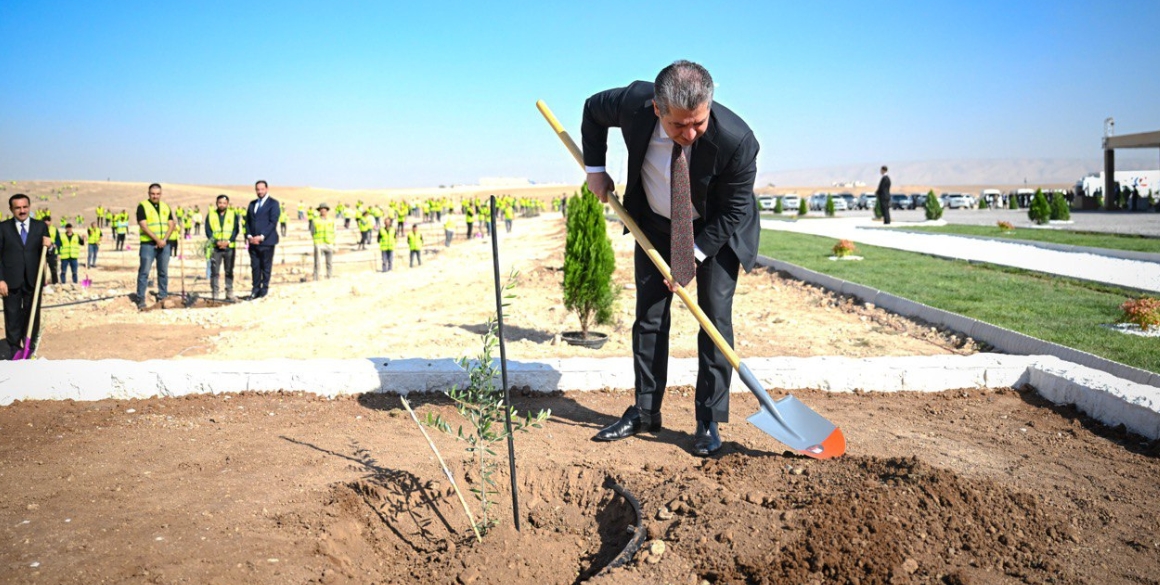
Prime Minister Masrour Barzani launched the first Green Belt project in the city of Erbil.
In a speech delivered at the inauguration ceremony, the Prime Minister emphasized the importance of the project for cleaning and greening Erbil. He also warned that due to climate change and desertification, people could eventually be forced to migrate. Such migration, he cautioned, would not stop within the Kurdistan Region but would extend toward Europe as well. Therefore, he called on those countries to support the Kurdistan Region in implementing its environmental and sustainability projects in order to curb desertification and mitigate the effects of climate change.
I planted the first tree of Erbil’s Green Belt today — a 7 million tree project that will raise the capital’s green coverage to 25%.
We should not wait for miracles; we must create miracles ourselves. pic.twitter.com/j9JEQ1kJxs
— Masrour Barzani (@masrourbarzani) October 30, 2025
At the same time, the Prime Minister pointed out that the project is part of the Kurdistan Regional Government’s broader plan to diversify its economy and revenue sources, noting that the private sector will benefit from the olive trees cultivated through this initiative.
Below is the full text of his speech:
In the name of Almighty and Merciful God,
Dear guests, welcome.
I am delighted to be with you today on this important and historic occasion, which truly matters both for the future generations and for the Kurdistan of today—its prosperity and development.
Mawlana Jalaluddin Rumi once said: “A flower blooms because of rain, not because of thunder.” Likewise, we continue, calmly and steadily, to build and beautify Kurdistan.
I would like to extend my gratitude to our Greek friends and experts who are present today, as well as to the government representatives, ambassadors, and specialists who have supported the implementation of this project—especially the planting of olive trees. Some time ago, I met with them and discussed how olive trees originally came from this region. Bringing them back to these lands carries deep meaning: it produces a blessed and valuable product for our people, while also serving the purpose of establishing Erbil’s Green Belt.
I also thank the private sector for assisting the government in realizing this project. I want citizens to understand that this green belt belongs to everyone; it symbolizes our collective commitment to a greener life. The Ministry of Municipalities will ultimately oversee it, but the private companies participating with the government in implementing it will continue to benefit—especially through the commercial use of the olive products grown here. Productive trees mean jobs for our young people. Our partners have also pledged to train the youth who wish to work in this field, enabling them to participate effectively in the care and maintenance of this Green Belt.
A Green Belt surrounding the city of Erbil will undoubtedly have a strong positive impact on the city’s climate. It will absorb carbon dioxide (CO₂), release oxygen, and help create a cleaner and healthier environment for all of us—leading to purer air, better health, and greater well-being for citizens.
All these projects stem from our continuous efforts to best serve our citizens and our beloved homeland.
Our government’s agenda has long aimed to diversify the economy of the Kurdistan Region so that we are not dependent solely on oil and gas or on a single sector. We are striving to advance all sectors simultaneously. Just a few days ago, you witnessed our projects in tourism and infrastructure; today, we also highlight environmental protection as a crucial aspect of both public health and economic opportunity. Clean air and a healthy environment will become lasting sources of income and quality of life for our people.
The initiatives we undertake—building ponds, dams, and now this Green Belt—are all designed to help us make sustainable use of our natural resources. Expanding this Green Belt will greatly support the purification of Erbil’s air and water. Like lungs for the city, it will allow residents to breathe cleaner air. There is an old saying: “Our ancestors planted so that we may eat; now we plant so that our descendants may eat.” I hope you yourselves will see and enjoy the fruits of these efforts.
This project creates jobs for young people. Beyond that, we hope that other government initiatives will reduce our dependence on single revenue sources. Training people in such projects strengthens their skills and gives our youth more opportunities and choices in the job market.
Before starting this and other projects, our hope was to move forward quickly with several similar initiatives. Unfortunately, we faced many challenges due to limited cooperation, which slowed progress. Yet through persistence, dedication, and the tireless efforts of my colleagues in the ministries and offices involved—who worked with true commitment—we were able to continue. I sincerely thank them for their perseverance and hard work.
We do not expect miracles from others. If no one helps us, we will still continue. But if anyone wishes to assist us, we will greatly appreciate it. I have already heard from many of our partners abroad who have expressed readiness to support this initiative, and I thank them sincerely. I also welcome the private companies who wish to participate further and assure them of our appreciation and cooperation.
Environmental protection and climate change are not only local issues. Their impact reaches all of Iraq and indeed the entire world. In almost every meeting—whether inside or outside the region—we have emphasized the need to take these issues seriously. The actions we take today will shape our tomorrow. We must act now to protect our environment, our way of life, and even the demographic stability of our areas.
Where water disappears, greenery fades, and life becomes impossible, people think of migration. That migration does not stop here—it reaches other parts of the world, especially Europe. People move in search of life. Desertification here eventually means migration there. This is why we have urged other countries to support us from the beginning—to ensure that climate change does not become yet another driver of migration. Addressing the problem at its source helps everyone: it benefits us, and it benefits them by reducing the future social, political, and security challenges that mass migration can bring.
As the Kurdistan Region, we have already taken tangible steps—building dams, expanding renewable energy projects, and reducing environmental pollution in our cities. These are practical, visible efforts.
Finally, I want to say this: we are not waiting for miracles to happen; we must create the miracles ourselves. We can rebuild and revitalize our country with our own hands. The caravan of progress that has begun in Kurdistan must continue. I hope you will all support us in this mission.
Thank you very much. Welcome again, dear guests.
May Kurdistan always prosper.
original article (in Kurdish)
—